
Aerocar Flies On
By Tom Snow
Courtesy of EAA, AirVenture
|
|
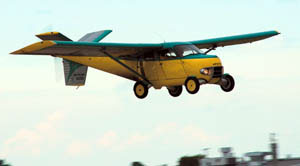
It REALLY
flies! Really! The rare
Taylor Aerocar flies like an airplane and drives like a car—once you
land
and separate the one- piece wing-and-tail combination. Photo by Dave
Higdon
|
Molt Taylor’s dream of a
practical
flying car lives on. The current keeper of the flame, Ed Sweeney, has
been
flying Taylor’s vintage 1956 Aerocar at AirVenture all week, plus he’s
currently developing a modern version based on a Lotus Elise sports car.
It would seem that
Sweeney was destined
to carry on for Taylor, a well-known experimental aircraft designer who
died in 1995. Taylor developed his first flying car in 1949.
In 1959, when a young
Sweeney was looking
for a place to fly model planes, he ended up at Taylor’s private
airstrip
in Longview, Washington. He and Taylor quickly struck up a friendship,
and it wasn’t long until Taylor gave Sweeney his first flying lesson in
the left seat of the Aerocar he now owns today. His is the only Aerocar
still flying. Four other examples of Taylor’s flying car, which never
went
into production, are in museums.
Sweeney and the Aerocar
would not be
reunited until 1988, when he spotted an ad in Trade-A-Plane. By then he
was living in Black Forest, Colorado. “I literally ran to the phone to
call the owner,” said Sweeney. “If it could be made airworthy, I knew I
had to have it.”
Taylor sold this
particular Aerocar,
Serial No. 4, to TV actor Bob Cummings, who owned it from 1960 to 1965.
A suave ladies’ man, Cummings often used his Aerocar to fly from Van
Nuys
to Palm Springs, California. Passengers included Marilyn Monroe and
Lana
Turner.
The Aerocar then
progressed through
four more owners, none of whom actually flew it. An owner in Illinois,
who had a chain of hamburger stands, used the Aerocar in parades for
publicity.
His sons also drove the car to high school everyday, minus the
detachable
wings. It was then stored in a building that collapsed on it.
|
|
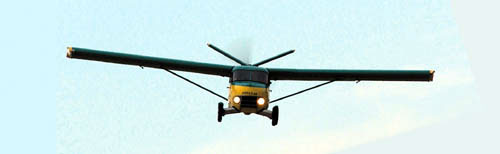
Photo by Dave
Higdon
|
“That this Aerocar
survived is amazing,”
said Sweeney. “We had to rebuild the tail and replace the leading edges
of the wings.” Both Sweeney and his wife, Sandra, are A & P
mechanics,
and they’ve owned other interesting planes,such as a Messerschmitt
209.
Sweeney loves to
demonstrate his Aerocar,
which he describes as easy to fly, although underpowered. The 180-hp
Lycoming
0-360 only produces 120 hp in the Aerocar due to an inefficient air
intake
system. It takes off at 50 mph and cruises at 90. Sweeney trailers the
Aerocar to air shows.
“You fly this plane with
the rudder
pedals and trim control,” explains Sweeney. “It’s very stable and makes
nice turns with rudder only. The steering wheel controls the ailerons
and
the front wheels. After landing, the wings can be detached and towed
behind
the car like a trailer. When used on the road, the engine powers the
front
wheels instead of the pusher prop.
“People love to see me
put it in reverse
and back up on the runway,” said Sweeney, who predicts his Aerocar will
end up in the Smithsonian someday. For now, it’s on display on the
flight
line near the big arch north of air show center.
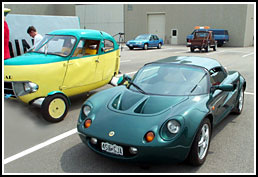 Ed
Sweeney, owner of the historically significant 1956 Molt Taylor
Aerocar,
hopes to soon make some aviation history of his own by developing a
modern
and practical flying car based on a 1,430-pound, two-seat Lotus
Elise. Ed
Sweeney, owner of the historically significant 1956 Molt Taylor
Aerocar,
hopes to soon make some aviation history of his own by developing a
modern
and practical flying car based on a 1,430-pound, two-seat Lotus
Elise.
“We’re about two
years away from flying,”
says Sweeney. “The Lotus is the ideal car to use for this project. It’s
a current production model, and it comes from the factory with an
aluminum
frame, aerodynamic fiberglass body, and completely enclosed belly pan.
The Lotus factory in England has been very supportive; they will begin
selling the Elise in the United States next year.”
To save 200 pounds,
the car’s original
engine has been replaced with a 3-cylinder engine and transmission
combination
from a Chevrolet Sprint. Rather than trying to use this small engine to
power the car in flight, a twin-turbo Lotus 350-hp V8 will be installed
in a separate “flight module,” which will be connected to the car
before
flight via six pinned attach points.
In addition to the
powerful engine
and tractor prop, the flight module includes a set of wings and the
tail.
Unlike the original Aerocar, these wings are not designed to be towed
behind
the car on the road. Sweeney envisions storing the flight module at the
airport and sharing it with several other flying car owners. Sweeney
has
the actual car and a scale model of the flight module on display beside
the original Aerocar.
Everyone dreams of
getting above the
freeway and out of traffic, and Sweeney claims that there is renewed
interest
in flying cars by Detroit automakers. Be sure to get the video,
here at StrangeBirds.com!
|
This story
and all content,
logos, pictures, and videos are the property of EAA Copyright
©
2002
 Aerocar:
Giving the Automobile Its Wings Aerocar:
Giving the Automobile Its Wings
Produced in
cooperation
with designer/inventor Moulton B. "Molt" Taylor, this video features
rare
test flight footage, interviews, scale models, drawings, significant
photographs
and press clippings of all four models of the AEROCAR - the "roadable"
airplane.
Item
#SBVCAR $10.00
Shopping...
Information...
StrangeBirds.com
All rights reserved. copyrighted 1998-2008
|